
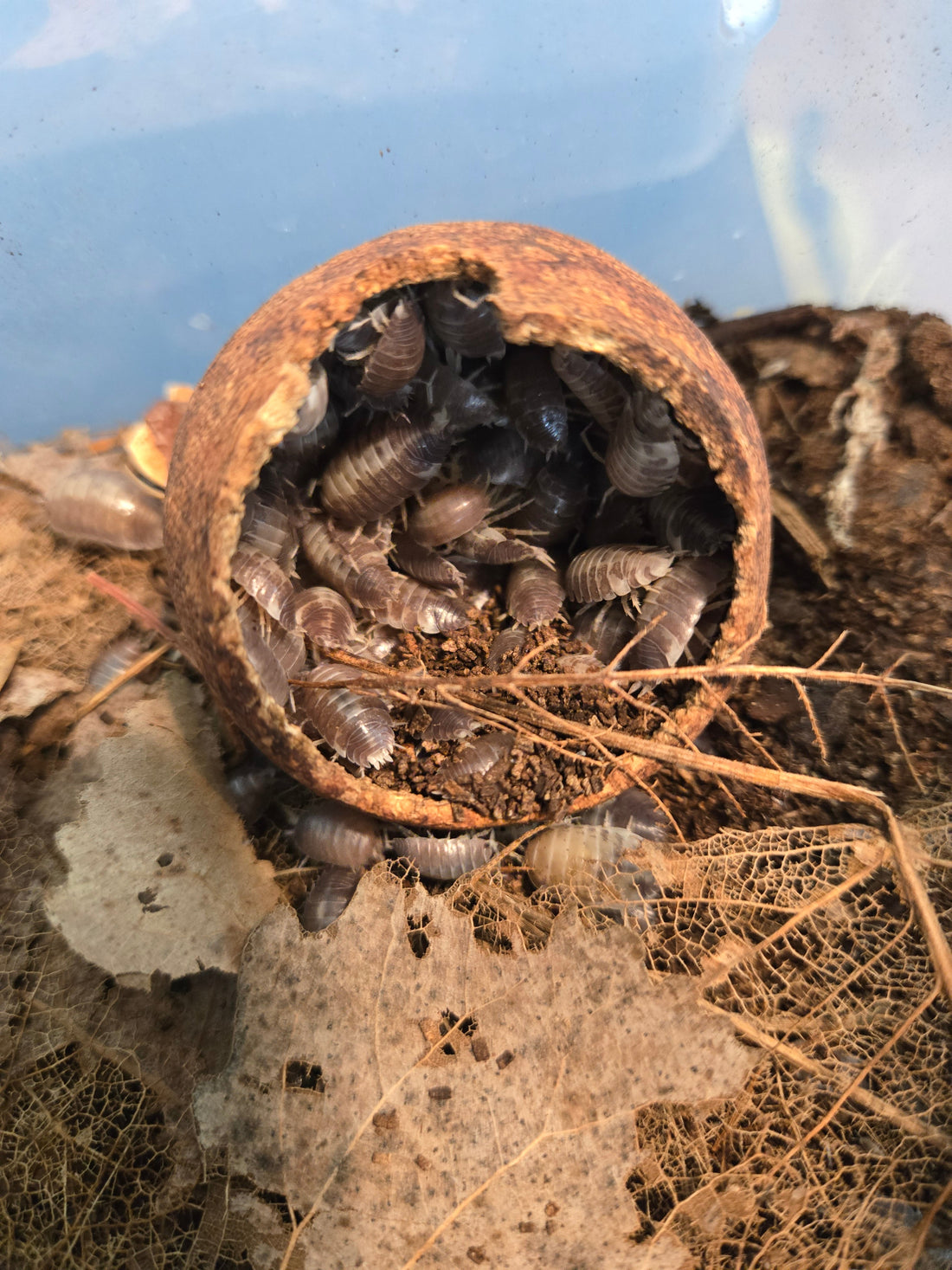
A bioactive enclosure is more than just a terrarium with live plants. It's a self-sustaining, living ecosystem — one that mimics the complexity of nature so closely that it largely takes care of itself. At the heart of every successful bioactive setup is a thriving community of microorganisms, plants, and clean-up crew animals working together in balance.
Botanicals and seed pods are one of the most important — and often underappreciated — elements of that ecosystem. In this guide, we'll break down the essential components of a bioactive enclosure and explain exactly what role botanicals play in making it all work.
What Is a Bioactive Enclosure?
A bioactive terrarium or bioactive vivarium is an enclosure designed to function as a living ecosystem. Rather than relying on the keeper to manually clean waste, replace substrate, and sterilize surfaces, a bioactive enclosure uses a living clean-up crew — primarily isopods and springtails — to process waste, consume decaying plant matter, mold, and fungi, and cycle nutrients back into the substrate.
The result is an enclosure that is more naturalistic, more stable, and often lower maintenance than a traditional setup — and one that provides a far richer environment for the animals living in it.
The Essential Elements of a Bioactive Enclosure
1. Drainage Layer
The foundation of any bioactive enclosure is a drainage layer — a layer of porous material (leca, gravel, or hydroballs) at the bottom of the enclosure that prevents the substrate from becoming waterlogged. A drainage layer is essential for maintaining the moisture balance that plants, isopods, and springtails need without creating anaerobic conditions that kill beneficial microorganisms.
2. Substrate
Above the drainage layer sits the substrate — the living soil of your bioactive enclosure. A good bioactive substrate is rich in organic matter, well-aerated, and capable of supporting both plant roots and a thriving microfauna population. Common mixes include coconut fiber, organic topsoil, sphagnum moss, and sand in varying ratios depending on the species being kept.
The substrate is where most of the biological activity happens — isopods and springtails live and breed here, beneficial bacteria break down waste, and plant roots anchor and grow. Botanicals on and in the substrate feed this entire system.
3. Live Plants
Live plants are a cornerstone of the bioactive enclosure. They absorb waste products (particularly ammonia and nitrates), produce oxygen, regulate humidity, and provide naturalistic cover and enrichment for the enclosure's inhabitants. Plant selection depends on the species being kept and the humidity and temperature requirements of the enclosure.
4. Clean-Up Crew: Isopods and Springtails
The clean-up crew is what makes a bioactive enclosure truly self-sustaining. Isopods and springtails are the workhorses of the bioactive ecosystem:
- Isopods — consume waste, decaying plant matter, shed skin, uneaten food, and dead insects. They also aerate the substrate as they burrow, improving drainage and oxygen flow. Popular species include Porcellionides pruinosus (Powder isopods), Porcellio laevis, Porcellio scaber, Armadillidium vulgare, Cubaris murina, and Trichorhina tomentosa (dwarf white isopods).
- Springtails — microscopic arthropods that consume mold, fungi, and bacteria on the substrate surface. They are the first line of defense against mold outbreaks and are essential in high-humidity enclosures where mold growth is a constant challenge.
For a clean-up crew to thrive, it needs food, shelter, and the right humidity. This is where botanicals become essential.
5. Hardscape
Cork bark, driftwood, rocks, and other hardscape elements provide structure, climbing surfaces, and hides for the enclosure's inhabitants. They also create the microhabitats that isopods and springtails colonize — the dark, humid spaces under bark and wood are prime real estate for a thriving clean-up crew.
6. Botanicals and Seed Pods
Botanicals — dried seed pods, leaves, cones, and wood — are the final and often most transformative element of a bioactive enclosure. They are the bridge between the living and non-living components of the ecosystem, and they fulfill multiple critical roles simultaneously.
The Role of Botanicals in a Bioactive Terrarium
Natural Food Source for the Clean-Up Crew
This is the most important role botanicals play in a bioactive enclosure. Botanicals including leaf litter and seed pods contain beneficial bacteria — exactly what isopods and springtails feed on. A bioactive enclosure without botanicals is like a pasture without grass: the animals are there, but the food isn't.
Different botanicals break down at different rates, creating a continuous, varied food supply:
- Fast-breaking botanicals (catappa leaves, cotton flower pods) — provide an immediate food source
- Long-lasting botanicals (lotus pods, bell cups, acorn caps, talami pods, bakuli pods, pear pods, jungle pods, ram's horn pods) — break down slowly over months, providing structural hides and long-term food sources
Microfauna Hotspots
Seed pods with complex structures — particularly lotus pods, mini lotus pods, and bell cups — become microfauna hotspots: dense concentrations of isopod and springtail activity where the population congregates, feeds, and breeds. These hotspots are visible evidence of a thriving bioactive ecosystem and are one of the most satisfying things to observe in a well-established enclosure.
Shelter and Breeding Sites
The chambers, cavities, and curved surfaces of seed pods provide shelter and breeding sites for isopods and springtails. Isopods are vulnerable during molting and seek out dark, enclosed spaces — the interior of a lotus pod or the curve of a ram's horn pod is ideal. Springtails breed in the moist, crevices of pods and cones.
Humidity Retention
Botanicals absorb and slowly release moisture, helping to maintain the humidity gradient that most bioactive enclosure inhabitants require. Fibrous botanicals like coco flowers, lotus seed pods, and jungle pods are particularly effective at retaining moisture and creating humid microhabitats within the enclosure.
Naturalistic Aesthetics
Beyond their functional roles, botanicals make a bioactive enclosure visually appealing. A layer of leaf litter, a cluster of seed pods, and a few scattered cones create the look and feel of a real forest floor — naturalistic, textured, and alive. This aesthetic is not just pleasing to the keeper; it provides the visual complexity and environmental enrichment that animals in the wild experience every day.
Substrate Enrichment
As botanicals break down completely, they become part of the substrate itself — adding organic matter, improving moisture retention, and feeding the beneficial bacteria and fungi that make the substrate biologically active. Over time, a well-maintained bioactive enclosure with regular botanical additions develops a rich, living substrate that supports increasingly complex microfauna populations.
Best Botanicals for Bioactive Enclosures
Here are our top picks for building a thriving bioactive botanical layer:
- Catappa Indian Almond Leaves or any hardwood leaf litter — the essential botanical; nutritious and long-loved by isopods and springtails
- Lotus Seed Pod Heads — the iconic microfauna hotspot; honeycomb chambers provide shelter, breeding sites, and sustained food
- Mini Lotus Seed Pods — perfect for nano enclosures and springtail harvesting
- Small Bell Cups — cup-shaped hides that isopods pack into; excellent foraging surfaces
- Sponge Mushroom Caps — textured with crevices; a favorite for isopods and springtails
- Casuarina Cones — small, textured, and quickly colonized; great for springtail cultures
- Coco Flowers — fibrous and moisture-retaining; excellent for all bioactive setups
- Ram's Horn Seed Pod — unique curved shape provides shelter and foraging surfaces; an isopod and springtail favorite
- Palm Tail Ball — fibrous ball that springtails colonize readily; excellent for springtail harvesting
How to Add Botanicals to a Bioactive Enclosure
Unlike aquarium botanicals, terrarium botanicals do not need to be boiled or sterilized. In fact, sterilizing them would remove the beneficial bacteria that make them valuable to your clean-up crew. Simply:
- Add directly to the enclosure — on the substrate surface, tucked under cork bark, or scattered throughout
- Let nature take over — any mold that appears is natural and beneficial; your clean-up crew will consume it
- Replenish regularly — add new botanicals as old ones break down to maintain a continuous food source
Building Your Bioactive Botanical Layer
A well-stocked bioactive botanical layer includes a mix of:
- Leaf litter base — leaves scattered across the substrate surface
- Structural pods — 1–2 larger pods (lotus, ram's horn, bell cups) per square foot of enclosure floor
- Smaller botanicals — casuarina cones, bakuli pods, dysoxylum pods, acorn caps, and cotton flowers scattered throughout
- Specialty items — sponge mushroom caps and palm tail balls as dedicated microfauna hotspots
Replenish the leaf litter every 2–4 weeks and add new pods as old ones break down. Over time, your enclosure will develop its own rhythm — a living, evolving ecosystem that gets better with every passing month.
Ready to build your bioactive botanical layer? Browse our full Terrarium Botanicals collection or our Isopod and Springtail Botanicals collection to get started. Not sure where to begin? Our Botanical Seed Pod Variety Packs are the perfect way to explore a wide range of botanicals at once.